


How to Check If Your Body Is Out of Balance: 4 Simple Self-Tests
Pelvic Tilt Self-Test at Home | Classical Osteopathy Centre Oakville

Think your hips are uneven? 4 simple at-home checks for pelvic tilt and body misalignment — the heel test, wall test, mirror test and standing signs. Gentle osteopathic assessment in Oakville.
Your body keeps score quietly
From an osteopathic perspective, a tilted pelvis is rarely a problem of the bones themselves — it is usually how your body compensates: tight hip flexors on one side, a weaker gluteal group on the other, or an old ankle sprain that quietly changed the way you walk.
According to an orthopaedic review published by Medscape, about 23% of the general population has a leg-length difference of 1 cm or more — one of the most common reasons the pelvis tilts and the body starts compensating.
Nobody wakes up one day with a tilted pelvis — it creeps in. You start shifting from foot to foot in a grocery line because standing still feels oddly tiring. At your desk you catch yourself tucking one leg under you and sitting on your own foot — and it feels better than sitting "properly". One shoe wears out faster than the other. Your belt sits a little crooked though your weight hasn't changed. None of this is dramatic enough to call a problem. But these are early warning signs: small hints that your body's balance has quietly shifted. The pelvis is the foundation everything stands on — when it tilts, the spine, shoulders and even the way you walk adjust around it. These four simple checks take a few minutes at home and can show you whether your body might be compensating. They don't diagnose anything — think of them as a way to listen to what your body has been trying to tell you.
And one more important thing — check your children. During growth spurts, a child’s body often can’t adapt fast enough: bones outgrow muscles and posture habits, and misalignments settle in quietly. A child often won’t complain — they’ll simply adapt around it. If you have kids, especially between 8 and 16, run these same checks on them. That’s when help is simplest.
Written by Dmytro Lozko, osteopathic practitioner at Classical Osteopathy Centre, Oakville. Member of ACMA (Alliance Canadienne de Médecine Alternative).
Test 1 — The heel check (lying down, 2 minutes)

Lie on your back on a firm, flat surface — the floor works better than a soft bed. Stretch your legs out straight and place them close together. Ask someone to gently hold both your ankles — not lifting, just keeping your legs straight and close together. Now compare your heels: are they level, or does one clearly extend further than the other? A visible difference — one heel “longer” — is a classic, simple sign often associated with a lateral pelvic tilt: when one side of the pelvis sits higher, the leg on that side can appear shorter. One caveat: most people have a slight natural difference in leg length, which by itself means nothing — so treat this as a reason to look closer, not a verdict. Don’t measure with a ruler; you’re looking for an obvious, visible difference. If your heels look even, that’s a good sign. If one is clearly ahead of the other, note which side — it’s useful information.
Test 2 — The wall check (1 minute, ask someone to help)
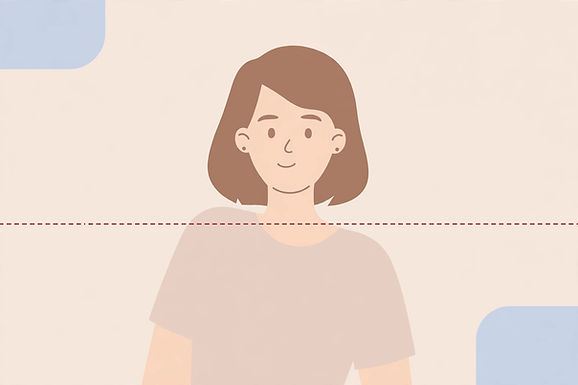
Stand with your back against a flat wall — heels, buttocks and shoulder blades touching it, shoulders pressed flat, standing tall and relaxed, the way you normally stand. Ask someone to stand in front of you and look at two things. First: are your shoulders level, or is one visibly higher than the other? Second: is your head straight, or does your neck tilt to one side? A visible shoulder difference or a head that leans sideways often goes together with a pelvic tilt — when the foundation is uneven, the upper body compensates. Don’t force a ‘perfect’ posture for the check; stand as you usually do.
Test 3 — The mirror check (1 minute, on your own)
Stand before a full-length mirror and place your hands on the bony edges of your pelvis (the iliac crests), palms flat and parallel to the floor. Are your hands level, or is one clearly higher? Small asymmetries are normal — nobody is perfectly symmetrical. What you’re looking for is something obvious: hands at noticeably different heights. It’s the same tilt the wall check looks for, just measured at the pelvis itself.
Test 4 — The standing check (no equipment, just observation)
If two or more of these checks raised a flag — one heel clearly ahead, uneven shoulders or a tilted neck at the wall, hands at different heights in the mirror, or constant weight-shifting while standing — that’s a solid reason to have it assessed properly. None of these tests is a diagnosis; together, they’re a reliable nudge worth listening to.
If these checks rang a bell, the next step is simple: come in for your first visit. In our experience, the main imbalances are often corrected in the very first session. Your visit is 45 minutes — we check how you stand, sit and move, assess your pelvis, spine and the whole chain, and give you an honest picture of what’s going on and what can realistically be improved. No cracking, no rush, no promises we can’t keep — just a clear understanding of your body and a plan. Book online or call +1 289-885-4210 — every appointment lasts 45 minutes.
Frequently asked questions
How accurate is this self-test?
It is a screening tool, not a diagnosis. These four checks can show whether your body may be compensating for a tilt — only a hands-on assessment can confirm what is really going on and whether it matters.
My child doesn't complain about pain — should I still run these checks on them?
Yes. Children adapt silently: during growth spurts their bones outgrow muscles and posture habits, and misalignments settle in without any complaint. Between 8 and 16 is when professional help is simplest and most effective.
Two or more checks raised a flag — what next?
Come in for an assessment. We check how you stand, sit and move, assess your pelvis, spine and the whole chain, and give you an honest picture of what is going on and what can realistically be improved.
How long is an appointment and how much does it cost?
Every appointment lasts 45 minutes and costs $140 CAD. First and follow-up visits cost the same.
Last updated: October 2026.
Get a professional read on your body


If two or more of these checks raised a flag — one heel clearly ahead, uneven shoulders or a tilted neck at the wall, hands at different heights in the mirror, or constant weight-shifting while standing — that’s a solid reason to have it assessed properly. None of these tests is a diagnosis; together, they’re a reliable nudge worth listening to.
If these checks rang a bell, the next step is simple: come in for your first visit. In our experience, the main imbalances are often corrected in the very first session. Your visit is 45 minutes — we check how you stand, sit and move, assess your pelvis, spine and the whole chain, and give you an honest picture of what’s going on and what can realistically be improved. No cracking, no rush, no promises we can’t keep — just a clear understanding of your body and a plan. Book online or call +1 289-885-4210 — every appointment lasts 45 minutes.
Frequently asked questions
How accurate is this self-test?
It is a screening tool, not a diagnosis. These four checks can show whether your body may be compensating for a tilt — only a hands-on assessment can confirm what is really going on and whether it matters.
My child doesn't complain about pain — should I still run these checks on them?
Yes. Children adapt silently: during growth spurts their bones outgrow muscles and posture habits, and misalignments settle in without any complaint. Between 8 and 16 is when professional help is simplest and most effective.
Two or more checks raised a flag — what next?
Come in for an assessment. We check how you stand, sit and move, assess your pelvis, spine and the whole chain, and give you an honest picture of what is going on and what can realistically be improved.
How long is an appointment and how much does it cost?
Every appointment lasts 45 minutes and costs $140 CAD. First and follow-up visits cost the same.
Last updated: October 2026.
Book your visit
Classical Osteopathy Centre
235 Lakeshore Rd E, Unit 202, Oakville, ON L6J 1H7
+1 289-885-4210
To book, go online or call us at +1 289-885-4210 — whichever suits you. Every appointment lasts 45 minutes.
Osteopathic care is a complementary manual practice and is not a substitute for medical diagnosis or treatment. Please consult your healthcare provider about any medical condition.