


Osteopathic Care for SI Joint Pain in Oakville
SI Joint Pain Oakville | Classical Osteopathy Centre

One-sided low back pain that feels like sciatica? It may be your SI joint. Gentle osteopathic care in Oakville may help. Book a 45-minute first visit.
When it's not really "back pain"
From an osteopathic perspective, sacroiliac joint pain is often the body's way of flagging a pelvic asymmetry. The small joint where the sacrum meets the pelvis barely moves, but that tiny movement carries your whole upper body into your legs — and when a past fall or injury leaves the pelvis sitting slightly uneven, the ache can mimic back pain or sciatica convincingly.
According to a peer-reviewed review in the journal Pain Practice, the sacroiliac joint accounts for roughly 16% to 30% of chronic mechanical low back pain cases.
You know the story: a deep ache low on one side, right where the back meets the buttock. Sometimes it shoots down the leg — so naturally you assume sciatica. Sometimes it just sits there, dull and stubborn — so you call it back pain. Creams, stretches, a new mattress… and it keeps coming back, because the culprit may be neither the back nor the sciatic nerve. It may be the sacroiliac joint — the small, strong joint where the sacrum meets the pelvis. It barely moves, but that tiny movement carries your whole upper body into your legs, and when it gets irritated it mimics back pain and sciatica brilliantly. Manual therapist John Gibbons teaches a useful key to this puzzle: the pelvic bone moves relative to the sacrum — and a past fall or injury, even years ago, can leave the pelvis sitting slightly asymmetric ever since. Find the asymmetry, and the "mystery pain" often starts making sense.
Written by Dmytro Lozko, osteopathic practitioner at Classical Osteopathy Centre, Oakville. Member of ACMA (Alliance Canadienne de Médecine Alternative).
Early warning signs of SI joint irritation

The body usually knocks long before it breaks down. Pain in the "dimple" above the buttock — almost always on one side. An ache when you stand on one leg, pull on trousers, or climb stairs. Sharp discomfort getting out of the car after a long drive — say, back from Toronto. Pain rolling over in bed at night. Ache after sitting through a long meeting or a movie. The feeling that one leg is "shorter," or that your belt sits crooked. These are early warning signs, not "just age" — the joint and its ligaments are asking for attention. At this stage things are easiest to help: the tissues haven't yet "memorized" the irritation, and a short course of care can often calm what months of ignoring would turn chronic.
How classical osteopathy may help with SI joint pain
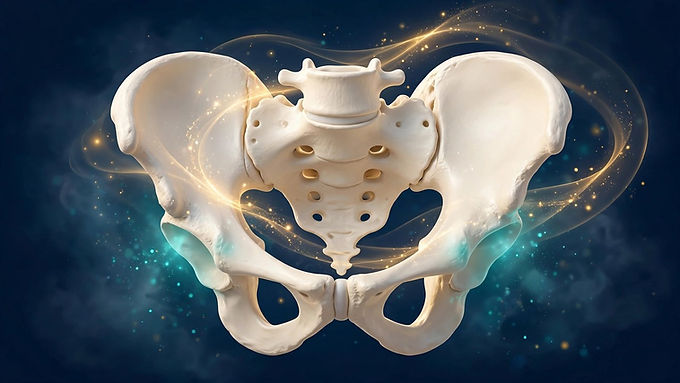
The sacroiliac joint is built for stability, not motion — it moves only millimetres. But those millimetres matter: when the joint and its ligaments are irritated, or the pelvic bones sit unevenly on the sacrum, every step and every sit-to-stand sends an uneven load through the pelvis, the lower back and the hips. Classical osteopathy looks exactly here — at the symmetry of the pelvis, the tone of the ligaments and the deep muscles that guard the joint. Gentle manual techniques may help ease the surrounding muscle tension, support more balanced pelvic mechanics and reduce the ache that the joint refers into the back, buttock or leg. We make no promises to "realign" or "click" anything back into place — the work is delicate, unhurried, and respects how little this joint likes to be forced. Visits are led by osteopaths Dmytro and Natalia.
What your first 45-minute visit looks like
Your first visit lasts 45 minutes — like every appointment — and there's no rush. First, a conversation: where exactly it hurts, on which side, what sets it off (getting out of the car? stairs? mornings?), what you've already tried — and whether there was a fall or injury in the past, even long ago. Then — an observation: how you stand, how the pelvis sits, how you move. Next — a careful hands-on assessment: the symmetry of the pelvic landmarks, where ligaments and muscles are tense, where movement is limited. Please note: we do not diagnose medical conditions — we assess the state of soft tissues and mobility to understand what to work with using our hands. And already at the first meeting you get a clear plan: what we saw, what we'll work on, and how many visits it will most likely take.
How many visits will you need?
If that one-sided ache keeps pretending to be back pain or sciatica — don't wait for it to settle in for good. Come in: we'll look at the pelvis and make a plan.
Frequently asked questions
How can you tell if it's the SI joint and not sciatica?
The symptoms overlap, which is exactly why this ache is so often misread. An osteopathic assessment looks at how your pelvis moves and where the load lands — that often clarifies whether the pain behaves like a pelvic pattern or a nerve pattern. If your story points to something that needs medical attention instead, we will say so honestly.
Can osteopathy help with SI joint pain?
It may help. When the sacroiliac joint is irritated because the pelvis sits slightly asymmetric, gentle osteopathic work aims to ease the surrounding tension and support more even load through the joint — addressing the pattern, not just the ache.
What does an appointment cost, and how long does it take?
Every appointment lasts 45 minutes and costs $140 CAD. First and follow-up visits cost the same.
How many sessions will I need?
It depends on how long the asymmetry has been there and how your body responds. Recent irritations often settle faster; patterns built over years usually need a longer plan. After your first visit, we can outline what makes sense for you.
Last updated: October 2026.
Visit us in Oakville

If that one-sided ache keeps pretending to be back pain or sciatica — don't wait for it to settle in for good. Come in: we'll look at the pelvis and make a plan.
Frequently asked questions
How can you tell if it's the SI joint and not sciatica?
The symptoms overlap, which is exactly why this ache is so often misread. An osteopathic assessment looks at how your pelvis moves and where the load lands — that often clarifies whether the pain behaves like a pelvic pattern or a nerve pattern. If your story points to something that needs medical attention instead, we will say so honestly.
Can osteopathy help with SI joint pain?
It may help. When the sacroiliac joint is irritated because the pelvis sits slightly asymmetric, gentle osteopathic work aims to ease the surrounding tension and support more even load through the joint — addressing the pattern, not just the ache.
What does an appointment cost, and how long does it take?
Every appointment lasts 45 minutes and costs $140 CAD. First and follow-up visits cost the same.
How many sessions will I need?
It depends on how long the asymmetry has been there and how your body responds. Recent irritations often settle faster; patterns built over years usually need a longer plan. After your first visit, we can outline what makes sense for you.
Last updated: October 2026.
Book your visit
Classical Osteopathy Centre
235 Lakeshore Rd E, Unit 202, Oakville, ON L6J 1H7
+1 289-885-4210
To book, go online or call us at +1 289-885-4210 — whichever suits you. Every appointment lasts 45 minutes.
Osteopathic care is a complementary manual practice and is not a substitute for medical diagnosis or treatment. Please consult your healthcare provider about any medical condition.